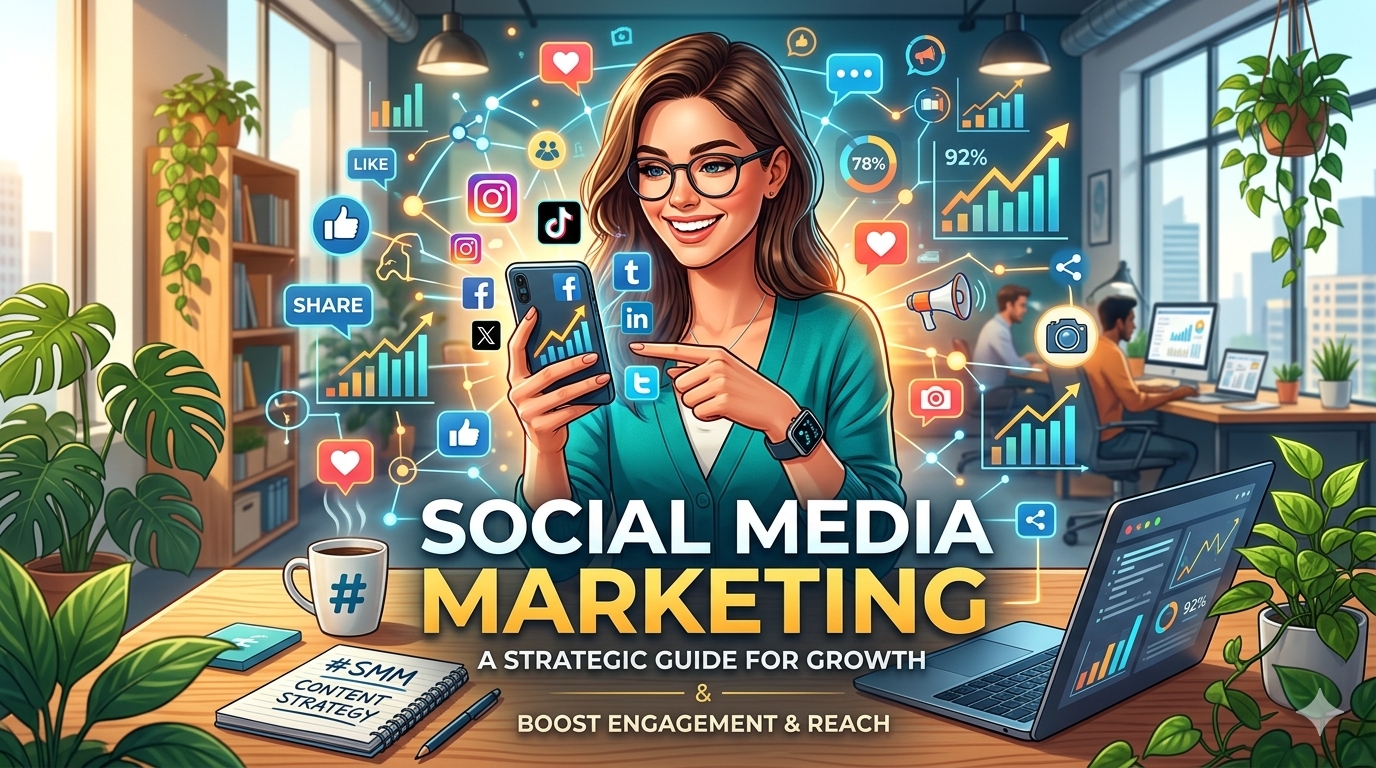
Social media marketing allows businesses to communicate with customers, build brand awareness, distribute content, and support business objectives through social platforms.
However, a successful social media marketing strategy requires much more than posting occasionally. Instead, businesses need clear goals, suitable platforms, useful content, consistent communication, and regular performance measurement.
What Is Social Media Marketing?
Specifically, social media marketing involves using social networking platforms to promote a business, communicate with audiences, distribute content, and support marketing objectives.
Depending on the business, this can include organic posts, short videos, stories, community engagement, influencer collaborations, and paid advertising.
Why Is Social Media Marketing Important?
Generally speaking, people use social platforms to discover brands, research products, communicate with businesses, and consume content.
Therefore, a well-planned social media marketing strategy can significantly help a business stay visible and maintain active communication with its target audience.
Choose the Right Platforms
Not every business needs to use every single platform simultaneously.
For instance, a B2B company may prioritize LinkedIn, while a fashion brand may focus more heavily on highly visual platforms. Consequently, before starting your social media marketing campaign, it is crucial to identify exactly where your target audience spends their time online.
Create a Content Strategy
A structured content strategy helps maintain consistency in order to build audience trust.
To achieve this, businesses can create different content categories such as:
- Educational content
- Product demonstrations
- Customer stories
- Behind-the-scenes content
- Frequently asked questions
- Industry news
- Short-form videos
- Promotional content
Ultimately, the best combination depends entirely on your unique audience and business objectives.
Short-Form Video
Short-form video has undoubtedly become an essential format across many major social platforms.
Specifically, businesses can use videos to demonstrate products, answer questions, explain concepts, show processes, or tell engaging stories. However, your content should always provide genuine value rather than simply copying passing trends.
Engagement
Crucially, social media is not only a broadcasting channel.
On the contrary, good social media marketing includes actively responding to comments, answering questions, acknowledging feedback, and participating in relevant conversations. By doing so, businesses can easily develop much stronger relationships with their audiences.
Paid Advertising
Organic content is only one part of social media. In addition, businesses can also use targeted paid advertising to reach highly selected audiences.
For example, paid campaigns can be used for goals such as awareness, website traffic, lead generation, app promotion, or direct sales. Nevertheless, advertising budgets should always be monitored carefully to ensure a positive return on investment.
Measure Performance
To track success, businesses should always define measurable goals before launching a campaign.
Specifically, useful metrics may include:
- Reach
- Impressions
- Engagement
- Video views
- Website traffic
- Leads
- Conversions
- Cost per result
As a rule, the appropriate metrics depend entirely on your specific campaign objectives.
Common Mistakes
Some businesses post without a strategy, copy competitors, focus entirely on promotional content, or ignore their audience.
Furthermore, another common mistake is judging success solely by follower count. In fact, a smaller but relevant audience may be much more valuable than a large audience with little to no interest in the business.
Final Thoughts about social media marketing
In conclusion, effective SMM perfectly combines strategy, creativity, consistency, and measurement.
To succeed, choose the right platforms, understand your audience deeply, publish useful content, interact with followers, and monitor meaningful results.
Frequently Asked Questions about social media marketing
- What is SMM?
Specifically, it is the use of social platforms to promote content, communicate with audiences, and support marketing objectives. - Which platform is best for business?
The best platform depends on the target audience, industry, content format, and business objectives. - How often should businesses post?
There is no universal number. Instead, consistency and overall content quality are much more important than posting simply to increase frequency.